Why Extending Your Home Almost Always Beats Moving
If you're reading this, chances are you've had the conversation. Maybe it happens over a Sunday breakfast, or during a frantic school-morning scramble: "We need more space." The kitchen feels cramped. There's nowhere quiet to work from home. The kids are sharing a bedroom and it's starting to cause friction. The instinct for many families is to start scrolling Rightmove, imagining a bigger house somewhere else. But before you call an estate agent, there's another option worth serious consideration; extending the home you already have.
The UK property market is tough. Stamp duty, estate agent fees, legal costs; they all add up fast. And at the end of it, you've spent tens of thousands just to move your belongings from one address to another. A well-designed extension gives you the space you need at a fraction of the cost, without giving up the home and neighbourhood you love.
This guide breaks down exactly why extending beats moving for most homeowners; with real numbers, a side-by-side comparison, and honest advice on when moving might actually be the smarter choice.
The true cost of moving; most people underestimate it
When people think about moving, they focus on the headline price of the new house. But the transaction costs alone are eye-watering; and most people drastically underestimate them.
Average moving costs at a glance
- Stamp duty on a £500k home: £12,000+
- Estate agent fees (1–3% of sale price): ~£15,000
- Legal fees, surveys & removals combined: £5,000+
That's a conservative £30,000–£40,000 gone before you've even bought a sofa for the new place. And you haven't added a single square foot of living space; you've simply relocated.
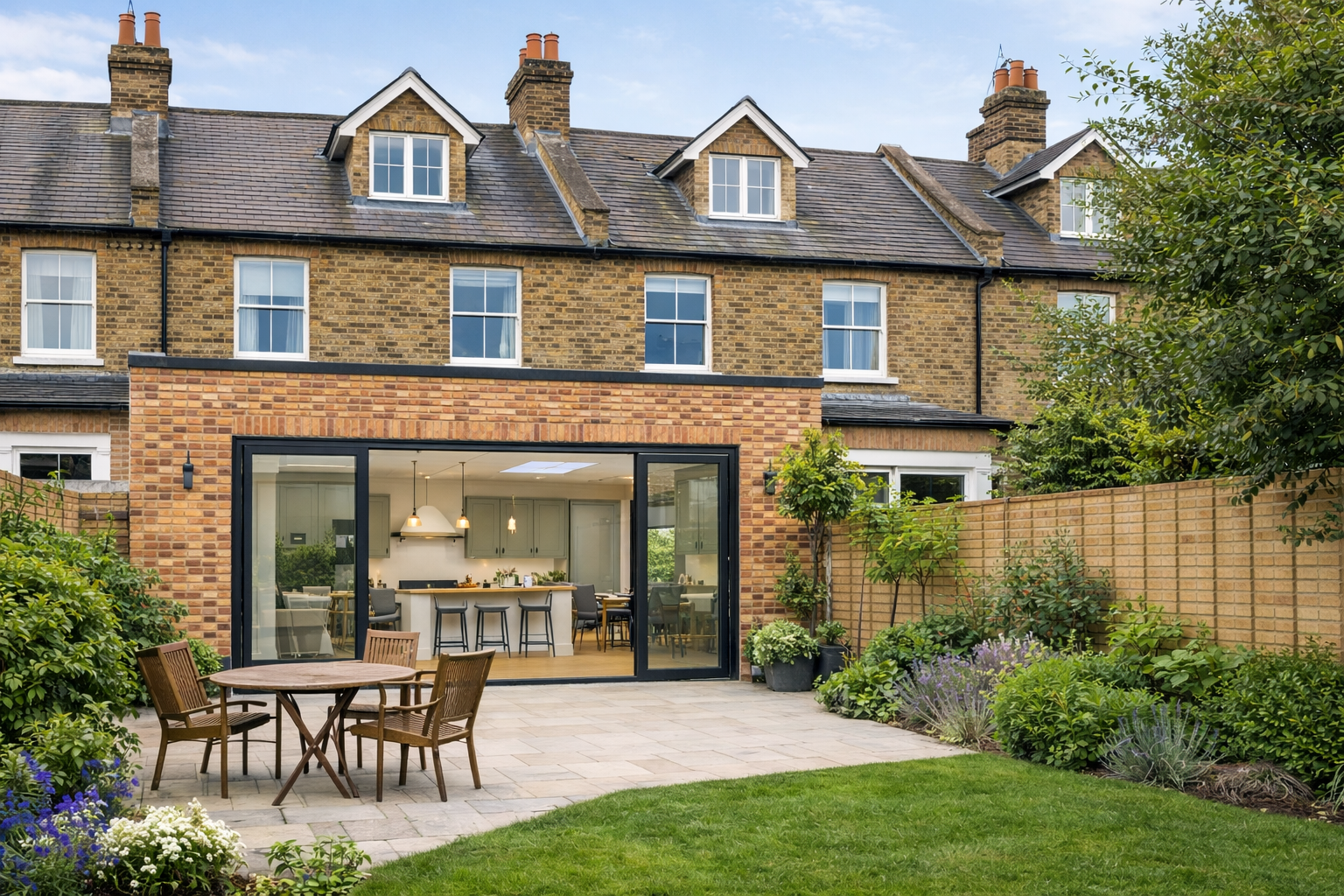
Contrast that with a single-storey rear extension, which typically costs £50,000–£80,000 and gives you a brand-new open-plan kitchen-diner tailored exactly to how your family lives. No compromises, no "making do" with someone else's layout.
Extending vs moving: a side-by-side comparison
Let's look at a common scenario. A family in London owns a three-bedroom Victorian terrace worth around £600,000. They need a fourth bedroom and a bigger kitchen. Moving to a four-bed in the same area means spending £750,000–£800,000; plus all the transaction costs. Or they could extend.
| Cost | Moving to a Bigger Home | Extending Your Current Home |
|---|---|---|
| Stamp duty | £15,000–£25,000+ | £0 |
| Estate agent fees | £9,000–£18,000 | £0 |
| Legal fees | £2,500–£4,000 | £0 |
| Removals & storage | £1,500–£3,000 | £0 |
| Premium to upsize | £100,000–£200,000+ | £0 |
| Design & build cost | £0 | £55,000–£120,000 |
| Added property value | — | +10–20% typically |
| Disruption | High; new schools, commute | Moderate; temporary during build |
The picture becomes even clearer when you factor in that a well-designed extension typically adds 10–20% to the value of your home. A significant chunk of your investment is recouped immediately, while moving costs are pure expenditure with no return.
You get to keep everything you love about where you live
It's easy to forget that a home isn't just bricks and mortar. It's your children's school places, the neighbours you actually get on with, the community you've built; the local café, the park, the GP surgery that finally knows your name. Your commute, your parking spot, the morning light through the bedroom window. These things have no price tag, but they matter enormously.
When you extend, you get the extra space without sacrificing any of that. You improve your home without uprooting your life.
According to data from Nationwide, adding a double-storey extension to a typical UK home can increase its value by up to 20%. A loft conversion typically adds around 15%. These are returns you'd never see from the cost of simply moving house.
What can you actually add with an extension?
This is where it gets exciting. Modern home extensions are far more than just "a box on the back."
Rear extension
The most common choice; and for good reason. A rear extension opens up the ground floor to create a larger kitchen, open-plan kitchen-diner, or family living space. Under permitted development, you can extend 3 metres from a semi-detached or terraced house (or 4 metres from a detached house) without needing planning permission. Costs typically range from £40,000 to £80,000.
Loft conversion
If bedrooms are the issue, a loft conversion is one of the most cost-effective ways to add space without reducing your garden. Victorian and Edwardian homes are often ideal candidates. A dormer conversion costs £45,000–£65,000, while a mansard runs £60,000–£85,000.
Side return extension
Common in Victorian and Edwardian terraces, a side return fills in the narrow passage running alongside the rear addition, adding 30–40% more width to your ground floor. Costs sit between £30,000 and £60,000.
Wraparound extension
Combining a rear and side extension into one continuous space, a wraparound delivers the most dramatic ground-floor transformation. Costs range from £70,000 to £120,000.
Common myths about home extensions; busted
There's a lot of misinformation out there. Let's clear up the most common ones.
I'll definitely need planning permission.
Many extensions fall under permitted development rights; a government scheme that allows certain builds without a full planning application. Single-storey rear extensions up to 4 metres (detached) or 3 metres (other houses) are frequently permitted development.
Extensions always go over budget.
This happens when projects aren't properly scoped and managed. With a fixed design fee, detailed technical drawings, and a vetted contractor, your budget is clearly defined from the start.
It'll take years and the disruption will be unbearable.
A typical single-storey rear extension takes 8–16 weeks to build once on site. Yes, there's disruption; but it's temporary and contained. Compare that to the upheaval of uprooting your entire family.
My house isn't right for extending.
Almost every home has some extension potential. The best first step is a feasibility consultation with a designer who can look at your specific property and tell you exactly what's possible.
When does moving actually make more sense?
To be fair, extending isn't always the right answer. If you're in completely the wrong location; perhaps your commute is unsustainable or you want to move closer to family; no amount of building work will fix that.
If your property's plot is very small and you've already maximised the footprint, there may be limited scope for extension. And if the home has fundamental structural issues (severe subsidence, Japanese knotweed, or an incompatible layout), it can sometimes make more financial sense to sell and start fresh. But for the vast majority of families who love their neighbourhood and simply need more space, extending is the smarter, more cost-effective route.
Frequently asked questions
How much does an extension cost per square metre?
In London, expect to pay £2,200–£3,500 per square metre for a high-quality single-storey extension. Outside London, £1,500–£2,500 per sqm is more typical.
Do I always need planning permission?
Not necessarily. Many extensions fall under permitted development rights, meaning no formal planning application is required. However, you should always check the specific rules for your property type and location.
How much value does an extension add?
As a general rule, a well-designed extension adds 10–20% to the value of your home. Loft conversions and open-plan kitchen extensions tend to deliver the strongest returns.
How long does the build take?
A typical single-storey rear extension takes 10–14 weeks to build, though the total process from initial design to completion is usually 5–8 months when you include design, approvals, and procurement.
Can I extend a semi-detached or terraced house?
Absolutely. Most London homes are terraced or semi-detached, and extensions are perfectly achievable. You'll need to consider party wall agreements with your neighbours, but this is a standard process that your architect will guide you through.
Ready to start your project?
Whether you're planning an extension, loft conversion, or full renovation, our team can guide you from first sketch to completion.