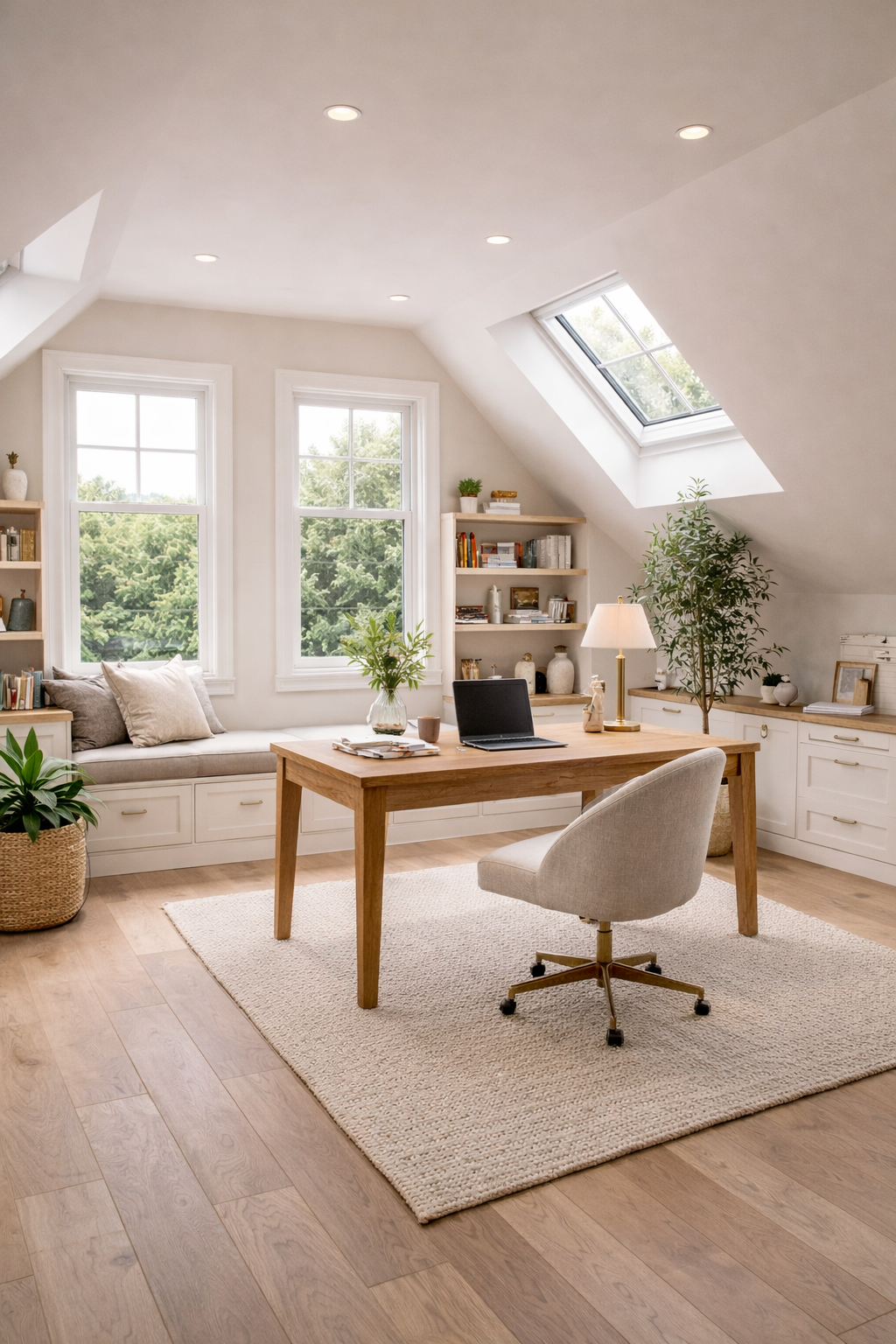
The Complete Guide to Loft Conversions
A loft conversion is one of the most popular and cost-effective ways to add space to a UK home. Unlike a ground-floor extension, it doesn't eat into your garden, and in many cases it can be carried out under permitted development. But not all lofts are suitable for conversion, and the type of conversion you choose will significantly affect both cost and outcome. This comprehensive guide covers everything you need to know.
Types of loft conversion
There are four main types of loft conversion, each suited to different property types and budgets. The right choice depends on your existing roof structure, the headroom available, and how much space you need to create.
| Conversion Type | Typical Cost | Planning Required? |
|---|---|---|
| Velux / rooflight | £30,000–£40,000 | Usually PD |
| Rear dormer | £45,000–£65,000 | Usually PD |
| Hip-to-gable | £50,000–£70,000 | Usually yes |
| Mansard | £60,000–£90,000 | Almost always yes |
| L-shaped dormer | £70,000–£100,000 | Depends on scope |
Velux or rooflight conversion
The simplest and cheapest option. Velux windows are installed into the existing roof slope without altering the roof structure. This works only when there's already sufficient headroom (at least 2.2 metres at the ridge). The advantage is lower cost (£30,000–£40,000) and minimal disruption, but the usable floor area is limited by the slope of the roof. Best suited to houses with steep-pitched roofs and generous loft spaces.
Dormer conversion
The most popular choice for London homes, particularly Victorian and Edwardian terraces. A dormer is a box-shaped structure that projects from the rear roof slope, creating a flat ceiling and vertical walls that dramatically increase the usable floor area. A full-width rear dormer maximises space and can comfortably accommodate a double bedroom with en-suite bathroom. Cost: £45,000–£65,000. Most dormer conversions fall under permitted development, making them straightforward from a planning perspective.
Hip-to-gable conversion
Common on semi-detached and detached houses where the roof slopes inward on the side (a "hipped" roof). The hip is rebuilt as a vertical gable wall, extending the loft space outward to the full width of the property. Often combined with a rear dormer for maximum space. Cost: £50,000–£70,000. This usually requires planning permission as it changes the roof profile visible from the street.
Mansard conversion
The most extensive (and expensive) option. A mansard conversion involves rebuilding the entire rear roof slope at a near-vertical angle (typically 72 degrees), creating the maximum possible internal volume. This is the best option for homes where existing headroom is limited. Mansard conversions almost always require planning permission and are common in London's Victorian and Georgian neighbourhoods. Cost: £60,000–£90,000.
Is your loft suitable for conversion?
The critical measurement is existing head height. You need a minimum of 2.2 metres from the top of the ceiling joists to the underside of the ridge beam. Anything less and a dormer or mansard conversion may still be possible, but a simple Velux conversion won't work. Other factors to assess include the roof structure (traditional cut timber rafters are easier to convert than modern trussed roofs, which require more structural work), the position of water tanks and services, and whether there's a viable route for the new staircase.
The absolute minimum head height for a habitable room is 2.2 metres at the highest point (the ridge). Building regulations require a minimum of 1.9 metres over at least 50% of the usable floor area. If your loft falls short, a dormer or mansard conversion can create the headroom you need; but a simple Velux conversion will not be viable.
Planning permission vs permitted development
Rear dormer conversions on non-listed houses outside conservation areas generally fall within permitted development. You're allowed up to 40 cubic metres of additional roof space on a terraced house, or 50 cubic metres on a detached or semi-detached house. Front-facing dormers always require planning permission. Mansard conversions and hip-to-gable works usually require planning permission. If your property is in a conservation area, listed, or subject to an Article 4 direction, you'll need to apply for planning permission regardless of the type of conversion.
Building regulations requirements
All loft conversions require building regulations approval, regardless of whether they need planning permission. The key requirements include structural adequacy of the new floor (the existing ceiling joists are rarely strong enough and usually need reinforcement or replacement), fire safety (a protected escape route with fire doors from the loft to the final exit, plus mains-wired interconnected smoke alarms on every level), staircase design (minimum 2-metre headroom, specific pitch and tread dimensions), thermal insulation (compliance with Part L), and sound insulation between the new room and the rooms below.
Party wall considerations
If your loft conversion involves work on or near a shared wall (party wall), you'll need to serve notice under the Party Wall etc. Act 1996. This is almost always the case with terraced and semi-detached houses, as the new floor structure will typically bear onto the party wall, and steelwork may need to be inserted into or against it. Allow 2–3 months for party wall matters to be resolved before construction starts.
Typical timeline for a loft conversion
- Initial design and survey: 2–4 weeks
- Planning application (if needed): 8 weeks
- Building regulations submission: 2–4 weeks
- Party wall process: 8–12 weeks (can run alongside planning)
- Procurement and contractor selection: 2–4 weeks
- Construction: 8–12 weeks for a dormer, 10–14 weeks for a mansard
- Total from start to finish: typically 6–9 months
Ready to start your project?
Whether you're planning an extension, loft conversion, or full renovation, our team can guide you from first sketch to completion.