Side Return Extensions: Making the Most of Wasted Space
If you own a Victorian or Edwardian terraced house in London, chances are you have a narrow alleyway running down one side of your property, linking the front to the back garden. This passage; known as the side return; is typically 0.9 to 1.5 metres wide and serves as little more than a place to store the bins. But that wasted strip of land can be transformed into genuinely life-changing additional living space through a side return extension.
What is a side return extension?
A side return extension is built over the narrow passage that runs alongside the original rear addition of a terraced house (the Victorian "back addition" or "closet wing"). By roofing over this space and removing the external wall of the existing kitchen, you can add 30–40% more width to your ground floor. It doesn't sound like much on paper, but the difference in how the space feels is transformative. A narrow galley kitchen that barely fits two people becomes a bright, open room where the family can cook, eat, and socialise together.
Best suited properties
Side return extensions work best on Victorian and Edwardian terraced houses with the classic two-storey rear addition (the "outrigger"). This layout is incredibly common across London; from Hackney to Brixton, Islington to Lewisham. The ideal property has a side return of at least 900mm width (measured from the outer wall of the rear addition to the boundary). Properties with wider side returns of 1.2–1.5 metres achieve the most dramatic results. Mid-terrace houses have a side return on one side only, while end-of-terrace properties may have passages on both sides.
Design options
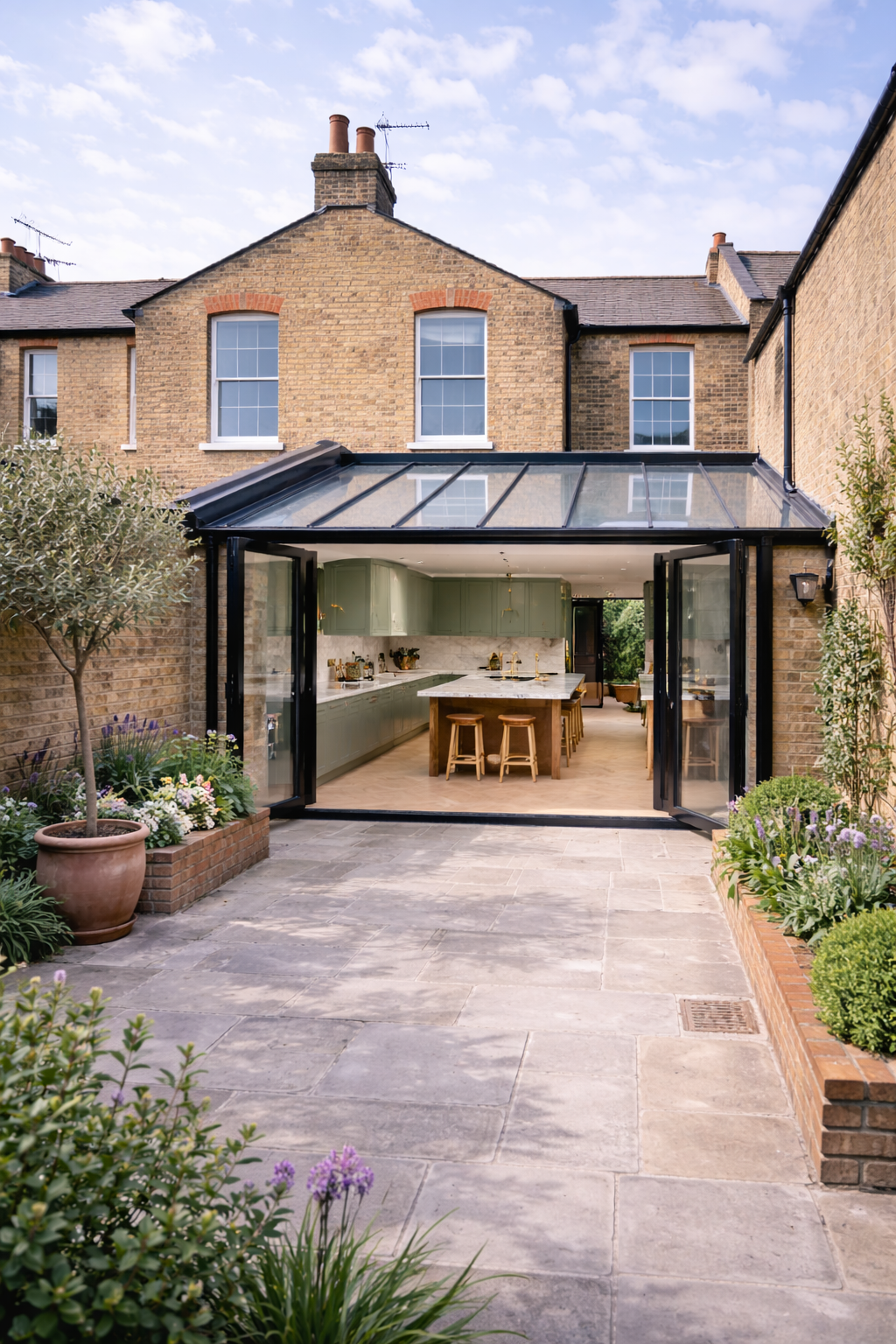
There are several approaches to designing a side return extension. A full-width infill extends across the entire side return from the rear of the main house to the back wall of the rear addition, creating one continuous open-plan space. A part-width infill leaves some of the side return open as a courtyard, which can help with natural light. The roof can be a glass rooflight (creating a stunning feature and flooding the interior with light), a flat roof with a skylight, or a pitched roof with zinc or lead cladding. Many of the most successful side return extensions use a long, continuous glass roof over the side return itself, creating a bright seam of light between the old and new parts of the kitchen.
Structural considerations
Removing the existing external wall to open up the kitchen requires a structural steel beam (RSJ) to carry the load of the wall above. This is typically the single biggest structural element in a side return extension and needs to be designed by a structural engineer. The beam is usually concealed within the ceiling void, so it's invisible in the finished room. Foundations for the new side return walls are usually standard strip foundations, though if you're building close to the boundary you may need to consider the depth of your neighbour's foundations and any tree roots.
Permitted development rules for side returns
Most side return extensions fall within permitted development, provided they meet the criteria: the extension must not extend beyond the rear wall of the original house by more than 3 metres (or 6 metres under the prior notification scheme for semi-detached/terraced houses), the height must not exceed 4 metres, and the eaves must not be higher than the existing house eaves. The extension must not cover more than 50% of the total curtilage. Materials should be similar in appearance. However, some London boroughs in conservation areas or with Article 4 directions may have removed PD rights, so always check with your local planning authority.
Side return extensions on terraced houses are limited to 3 metres depth under standard permitted development (or 6 metres via prior notification). If your side return runs the full length of the rear addition and you only want to infill it without extending further to the rear, you are usually well within PD limits. Always confirm with a Lawful Development Certificate.
Cost of a side return extension
A side return infill on its own (without extending to the rear) typically costs between £30,000 and £50,000. Combined with a rear extension; the most common approach; the total cost is usually £50,000 to £80,000 for the build, plus kitchen, flooring, and finishes. The glass roof element is often the most expensive component: a high-quality structural glass roof over a 5-metre-long side return can cost £8,000–£15,000 alone. Despite the relatively modest footprint, side return extensions deliver exceptional value because they transform the usability of the entire ground floor.
| Cost Element | Side Return Only | Side Return + Rear Extension |
|---|---|---|
| Build cost | £30,000–£50,000 | £50,000–£80,000 |
| Structural steel (RSJ) | £2,000–£4,000 | £3,000–£6,000 |
| Glass roof over side return | £8,000–£15,000 | £8,000–£15,000 |
| Kitchen & appliances | £10,000–£35,000 | £15,000–£45,000 |
| Professional fees | £4,000–£8,000 | £6,000–£12,000 |
| Total project cost | £55,000–£110,000 | £85,000–£155,000 |
The impact: before and after
The transformation a side return extension creates is hard to overstate. Before: a dark, narrow galley kitchen at the back of the house, separated from the dining room by a solid wall, with a view of a brick wall down the side passage. After: a bright, open-plan kitchen-diner stretching the full width of the house, with a glass roof washing natural light across the space and clear sight lines from the cooking zone to the garden. For many families, this single change is the moment their house truly becomes a home.
Ready to start your project?
Whether you're planning an extension, loft conversion, or full renovation, our team can guide you from first sketch to completion.